S2E2: The Boy in the Striped Pajamas

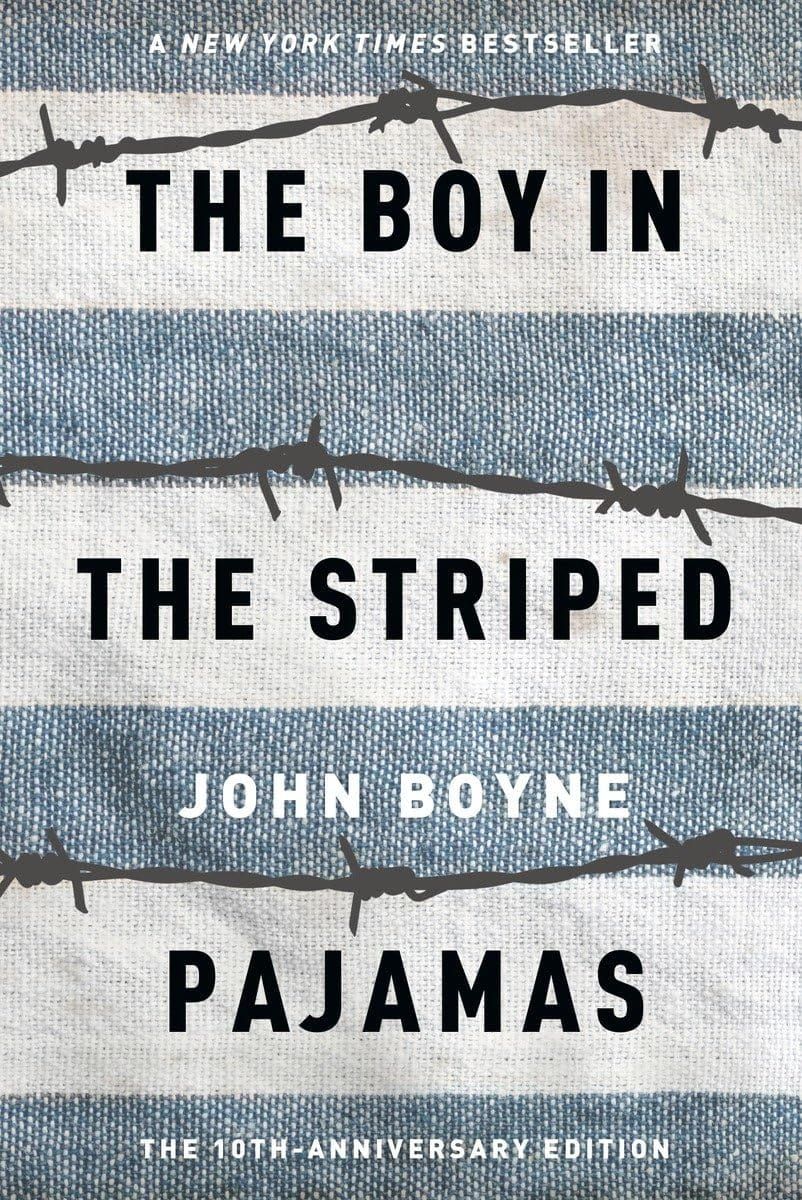
When it comes to the Boy in the Striped Pyjamas, it’s hard not to feel a little late to the party. I was just out of high school when this book came out. Bush was a lame duck president, TED Talks were saving the world, and I was too busy taking myself too seriously with my first Haruki Murakami to read some children’s book about fashion.
Apparently it was a massive hit, but it never really crossed my radar. Over the years, I had some idea about it. The Boy in the Striped Pyjamas sat in my mind as “some book about two boys with a sad ending.” Reading it for the podcast last week, I realized I always thought this and Bridge to Terabithia were the same thing. Now I know they different, but I don’t know what Bridge to Terabithia is about. I suppose it’s about bridges, and maybe… some sort of Italian dessert, or liqueur? It sounds nice.
The Boy in the Striped Pyjamas is a book about the Holocaust. The problem is, the book also tries really hard to not to be about the Holocaust. In fact, it might be the least “about the Holocaust” thing that I’ve read about the Holocaust.
The book is actually about a boy named Bruno, who is about nine and runs about Auschwitz without knowing about the death camp, about the war, about Nazis, about Jews, or even about Germans. For Bruno, that’s all much ado about nothing. This is confusing for the reader because Bruno is the son of the Nazi commandant running Auschwitz.
Bruno is only nine, but Boyne writes the character so cartoonishly innocent that it becomes ignorance. He witnesses the suffering on the other side of the fence and thinks it is a performance. He sees thin, decrepit hands of concentration camp victims, wonders why they look like that and then quickly moves on. He literally never heard the word “Jew” before. He doesn’t know what job his dad does. When Bruno says “Heil Hitler,” he assumes it’s just another way of saying “goodbye for now, have a pleasant afternoon,” even though he has previously met Hitler. Bruno also only refers to the Fuhrer as “the Fury,” he calls Auschwitz “Out-With.” If I could guess, I think Boyne might have thought these were each a clever play-on-words, but that doesn’t really make sense in the logic of the book where Bruno speaks German. It also makes little sense in a regime where Nazi ideology was imbedded from kindergarten.
Over the course of his stay, the befuddled Bruno befriends a young Jewish boy on the other side of the fence named Shmuel. Shmuel is a Jewish boy the same age as Bruno. After around a year of regular conversations, one day Bruno sneaks into the camp to help Shmuel find his father, who has gone missing. Shortly thereafter, they are both suddenly rounded up and killed in a gas chamber. Structurally, the book builds to that sudden ending, followed by a quick family epilogue reminiscent a fun summer camp story. Except in this case, summer camp is history’s most notorious deathcamp.
So, the book just takes place during the Holocaust but really, it’s more about friendship – that is the defence that Boyne has landed on, at least. That doesn’t really stack up, as Bruno and Shmuel neither build a deep friendship nor do they really act as good friends. When Shmuel is threatened by an SS officer in Bruno’s house, Bruno betrays him. This is despite Bruno challenging the officer at various other points in the book. When Bruno wants to climb under the fence into the concentration camp to help Shmuel look for his father, Shmuel obliges. This is despite Shmuel knowing full well the danger that presents. As /u/beaudashington brought up on the podcast discussion, it’s probably because Boyne wrote the whole thing with what he thought was a killer ending (a German boy, a Jewish Pole, both executed together holding hands) and he submitted the book to that purpose.
This commitment to the specific set-piece ending flattens the characters and hollows out the entire story. Outside of anything relating to the Holocaust, Bruno is a smart, precocious and articulate boy. Shmuel is probably just as smart, but he’s left to mutter away the reality of his situation because it would disrupt the ending Boyne needed to maintain.
Don’t believe me? After Bruno sells Shmuel out to the SS officer that Bruno previously saw beat another man to death, the next time they meet Shmuel is covered in bruises. Bruno wonders if Shmuel fell off a bicycle, and Shmuel waves it off.
This leads me to question Boyne’s “fable of friendship” defence on the matter of friendship. If the goal were to write friendship that breaks prejudice, would the story not be that Bruno came into the camp deeply bigoted and learned to see Shmuel for who he was despite indoctrinated hatred? Same so, Shmuel may have connected with a young individual who showed him kindness, even if that boy was from the people eradicating his family. But that would be a more challenging story to write. I couldn’t write it, just like Boyne couldn’t, but I’d try to write something less subservient to the exploitative, sentimentalist ending here.
Bruno doesn’t learn across the novel. From the point that he moves from Berlin to Auschwitz to his impromptu death in the gas chambers, he remains about as ignorant of the situation as he was at the start. There’s no great unveiling. He dies as an innocent, and despite the fact he’s a child, you’re left scratching your head a little at why you are following a character that learned nothing.
Among the handful of secondary characters, Boyne chooses to focus most on their implied or explicit opposition to, you know, what’s going on. Bruno’s mother and maid don’t like it. Eva Braun even makes an appearance as a beautiful, sweet woman. It all comes together to portray a Nazi Germany where a few bad men were going too far and everyone else was confused, ignorant, or opposed. This misses hard on the more important historical lesson of how society at large can be mobilized and embrace the darkest of evils. Unintentionally, Boyne tells a story of denialism.
It’s a cheap, exploitative and sentimentalist story from Boyne. It’s really a lot worse and more irritating than I expected, and the educational and cultural influence of the book are a bit unnerving. To some degree, I’m not sure how much he is responsible for broad miseducation about the Holocaust, because at least initially, he was just a guy that wrote a bad book, not someone on schoolboards or teaching in classrooms and he probably had no idea how widespread the influence would be.
That said, he is still cashing the cheques, and Boyne’s response to criticism is weak. He blames controversy over his TERF stance as the reason this book gets criticism, which is absurd. He handwaves direct criticism from the Memorial Museum of Auschwitz. He defends the book as fable, but fables don’t take place in the real world. He says it’s a story about friendship, but it’s not about the characters at all. He must be a smart enough guy, so these defences are too willfully ignorant to believe – a little bit like Bruno.
I didn’t love reading or reviewing this. There are too many angles to cover, and I feel a little out of touch with the rise and fall of Boyne. I think The Boy in the Striped Pyjamas has a future in classrooms, not in history or discussion of the Holocaust but in critical discussions in an English class. It is an accessible book for teenagers to unpack and discuss “what’s wrong with this?”
Speaking of highschool mentalities, we had a fine time discussing it on the podcast either way.