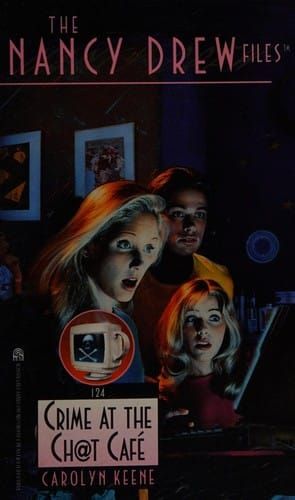
"Crime at the Ch@t Cafe" from the Nancy Drew Files by Carolyn Keene

I asked my mom about Nancy Drew recently, and she said "I loved Nancy Drew" in the same way that she talks about horses. If you don't understand what that means, you don't know horse people, and your mom probably didn't teach you how to braid ribbons into your pony's hair. But anyway, let's be clear: Nancy Drew is not a piece of shit.
In fact, she's a good detective. She has solved hundreds of mysteries, putting her up there with the best fictional detectives like Holmes, Poirot, and Conan Edogawa. Starting her career at 16 years old in 1930, by the time Nancy got to this week's book, 1997's Crime at the Ch@t Café, she'd have been 83 years old.
Crime at the Ch@t Café is a veteran Nancy Drew exploring a fantastical late 90s version of the internet. She's doing emails, she's tackling hackers, she's dealing with viruses that display a big skull and crossbones, but most of all she's surfing the web. Surfing the web? More like serfing the web these days - am I right folks?
In truth, Nancy spends more time "cyberwaitressing" than cybersurfing, because Crime at the Ch@t Café revolves around her, Bess, and George, on a mission to help a family friend set up a cyber café. What is a cyber café? It is explained in the first couple of pages:
"Working at the Ch@t Café is going to be so cool," George said. "I love the whole cyber café concept: relax with a couple friends, knock back a latte, and surf the Internet, all at the same time."
“What’s this relaxing bit?” Nancy joked. “We’re going to be up to our elbows in coffee grounds and keyboards.” A flight attendant leaned over Bess, who was sitting in the aisle seat.
“Did you want some more coffee?” he asked as he removed the girls’ trays. “Only if it’s served up by a computer geek,” Bess said, smiling.
An adult man across the aisle chimes in:
"Yeah, and hold the cream and sugar. Just bring me a Net connection with that."
The Ch@t Café (always spelled like that) is getting ready for a grand opening, but someone has been firing off threatening emails and sabotaging the place. The suspects don't really matter, but one of them is a rival cowboy-themed cyber café, and it is very cool. It has a steakhouse décor, and all the staff do Texan accents. No notes.
The plot progresses as you would expect: Bess is a bit flirty, Nancy is suspicious of everyone, and George does what she can. The attacks escalate, including a massive virus attack:
Each monitor flickered to life and displayed the usual hard-drive scan data. Unexpectedly, a frightening graphic of a skull and crossbones popped into view, then, one by one, each screen filled with a mushroom cloud explosion.
The speakers on PC #1 thundered. The ka-boom echoed throughout the café, tumbling from one computer to the next.
Interestingly, Stuxnet actually worked the same way. Anyway, most of the book is fun. At 150 pages, it flies. Sure, it didn't get everything about the internet right, but the book's cover did get YouTube thumbnails incredibly right:

So why are we looking at Nancy Drew? Well, we did the Hardy Boys, and Nancy Drew has a connected, complicated history. We also need breaks from some of the nauseating stuff.
Born of the Stratemeyer Syndicate's endless new ideas and endless appetite for new markets in the first half of the 20th century, Nancy ultimately became their golden goose when they took the chance that young girls like to read and that a self-assured, brash, and classy girl detective would work after the success of the Hardy Boys. Here is part of Edward Stratemeyer's pitch note to publishers, taken from Girl Sleuth: Nancy Drew and the Women Who Created Her by Melanie Rehak:
These suggestions are for a new series for girls verging on novels. 224 pages, to retail at fifty cents. I have called this line the “Stella Strong Stories,” but they might also be called “Diana Drew Stories,” “Diana Dare Stories,” “Nan Nelson Stories,” “Nan Drew Stories” or “Helen Hale Stories” . . . Stella Strong, a girl of sixteen, is the daughter of a District Attorney of many years standing. He is a widower and often talks over his affairs with Stella and the girl was present during many interviews her father had with noted detectives and at the solving of many intricate mysteries. Then, quite unexpectedly, Stella plunged into some mysteries of her own and found herself wound up in a series of exciting situations. An up-to-date American girl at her best, bright, clever, resourceful and full of energy.
The Stratemeyer Syndicate relied on a network of ghostwriters, who would sign away royalty rights, stay anonymous, and receive about $100 USD per book. One such author working for them was Mildred Augustine (later Mildred Augustine Wirt Benson) who was picked as perfect to write Nancy Drew. A small-town Iowan with a master's in journalism, Mildred wrote the first 7 books in the evenings while freelancing as a reporter and publishing her own books. Nancy Drew, of course, was published under the pen name Carolyn Keene.
Just as Nancy Drew launched, the Stratemeyer patriarch, Edward, died. The Stratemeyer scions, Edna and Harriet, took over with no experience in the business, going full steam ahead after failing to sell it. While in some ways a hardworking underdog in her own right, Harriet the girlboss didn't forget to gaslight and to gatekeep.
Harriet cut wages for the syndicate's ghostwriters and took more and more control as the characters became "IPs" fit for film and television. Mildred was gradually pushed out after writing 23 of the first 30 books, and after years of misdirects, Harriet came to declare herself Carolyn Keene, becoming famous from the 1960s onward. It was only after Harriet's death and sleuthing from diehards that Mildred got wide recognition in the 1990s for creating the original Nancy Drew.
Beyond the difference in popularity, Nancy Drew is more complex than the Hardy Boys. Of course, the oldest books are racist, and the Stratemeyer Syndicate was kind of a racket. But a teenage girl detective in 1930? Still solvin' computer crimes in 1997? A character forged by an anonymous, exploited female author who was working a day job, raising a kid, and chipped away at the typewriter by her dying husband's bedside for $100 a book?
Nancy Drew is good. Crime at the Ch@t Café is silly, fun and dumb. The Stratemeyer Syndicate has a special place in our exploration of literary piece-of-shittery.
I will leave you with the book's description of competitive gaming in 1997. The Ch@t Café has a gaming team, and they go head to head against the cowboy-themed cyber café in a match of Zero Dust! This is how that game is described:
The goal of the game was to be the first team to secure the treasure and get it back to its own Web site, earning points along the way for successfully repelling deadly attacks from the opposing gamers. Each team was to seek clues to identify the treasure's location while avoiding traps, blockades, and false evidence left by the opponent.
Do you understand how that game works? Me either. But I guess that's why none of us will ever be Nancy Drew.
If you’d like to hear four men entering the back nine of life talk '97 Nancy Drew, check out the full podcast discussion.