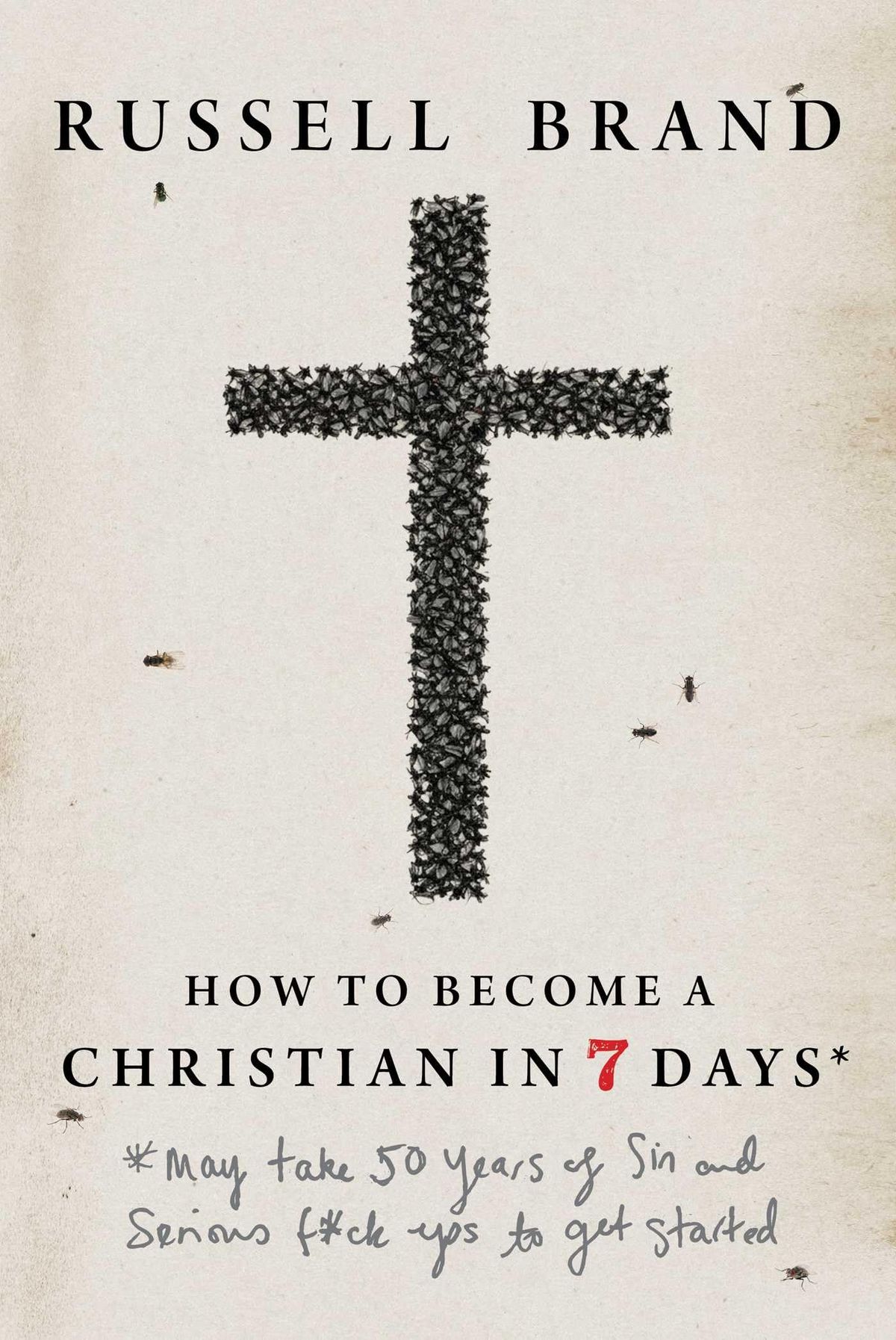
"How to Become a Christian in Seven Days" by Russell Brand

I used to be a Russell Brand fan.
I liked his stand-up comedy, even though I knew little about his public persona in the UK where he is from. He is clearly clever, verbose, and self-aware in his ridiculousness.
That changed in 2014 when I read Russell Brand’s book Revolution, an inane book arguing that people shouldn’t vote and that refraining from doing so would somehow bring about change.
I thought I couldn’t hate him more than I did, but then COVID-19 happened. Brand developed a lucrative online persona as a conspiracy theorist and vaccine denier, spreading fear and ignorance while claiming that vaccines had taken “millions” of lives. And I thought I couldn’t hate him any more than I did.
Then in 2023 a flood of allegations came out against him related to sexual assault. This isn’t the right place to go over those allegations in detail (for that, see this article in the Guardian), but let me just say that the allegations are not a few pinched bottoms or stolen kisses. They include decades of inappropriate touching, assault and violent rape. Brand engaged in serious and concerning behavior for decades. He groped women (and bragged about it on camera), regularly made inappropriate remarks under the guise of being a cheeky boy, made people uncomfortable, and has had people calling him out for sexual assault for a very long time.
And I thought: surely now I have reached the maximum that I can hate this man. I swore I’d never consume any of his media ever again. Not his podcasts, not his movies, and especially not his books.
But this is the Piece of Shit Book Club; the place where instead of avoiding the things you hate the most, you for some reason agree to read them with your friends and then write posts about them on Reddit and podcast about them. So, in spite of all my better judgment, here I am this week to discuss Russell Brand’s latest book How to Become a Christian in Seven Days.
You often hear about so-called “courthouse conversions”, when someone accused publicly of some crime or other suddenly and miraculously finds religion. Russell Brand will become the benchmark from which all future courthouse conversions will be measured, as there are few people who have led such a painfully obvious attempt to reset their public image through a sudden and VERY PUBLIC religious change. He has gone from the most publicly bragging anti-establishment, anti-tradition, anti-religion and pro-sin figure, to suddenly claiming to be a moral Christian man – and that’s what this book is here to show.
Reading this book is a challenge. Not because the ideas are complex – they are not – but because Brand thinks they are, and because he thinks the more clever-sounding words he crams into a sentence, the smarter he sounds. Consider this example:
“ChatGPT said that a modern perspective includes everything that a biblio-historical one does plus the evolution and advances of subsequent knowledge. I could tell that ChatGPT really thought it had me there but this is where I pressed in; “Why would you assume a telos of progress rather than of degeneration (matter degenerates over time) and that a modern reading of these events as human institutions, whether academic, legal, media, governmental or corporate might be obfuscating truth that was clearer in antiquity when we were closer to God, unity and essence?” At this, ChatGPT shat itself and changed the subject, putting, up the kind of holding screen that used to come on analog TV when the signal dropped”
All he is saying here is “why would you assume that people now know more than in the past?”. Although Brand can’t find the answer, it’s actually very simple: because scientific knowledge is cumulative. That’s it. And he thinks he’s a genius because ChatGPT went “Wow! You’re absolutely right, Russell. What a great point!”
Here’s another example:
“Consider that within you… there is a portion of the divine, shooting, roaming, spreading, and searching, and the function of the world is to entice, enchant, wrap, and shellac it, a new and choking womb. Enclosed in self. Trapped on an inward ricochet of solipsistic inner circuitry, caroming endlessly in here with constant wants and fears.”
This book is 200 pages of that drivel.
The small part of the human population that seems to like this book is made up mostly of people that don’t understand the words that Brand uses; take a look at the positive reviews on Goodreads and you’ll see what I mean. But people who do understand the words he uses mostly say the same thing: this book is as empty and poorly timed as Brand’s public conversion. Even conservative newspapers call the book trash. The Telegraph reviewed the book saying, “It is a criminally painful read and it is not a victimless crime”, adding “The poor fool of a reader suffers, but the victim I feel most sorry for is God.” The Times concluded, “Brand has swallowed a dictionary, and it is not coming out again via his mouth.”
Perhaps the worst part about the book is the constant bragging. Brand adopts the classic abuser stance of ‘so many women wanted me that I didn’t have to force anyone’, and never once addresses his constant inappropriate behavior in public. He gloats constantly about the amount of sex he had and how much better it was than any sex you ever sexed. Although he says that he was searching for something that Christianity now provides, he never says that he was wrong in his behavior, or that he shouldn’t have done it, or that he should be condemned. His excuse for everything is the same excuse for why he had a relationship with a 16-year-old (one of his accusers) when he was in his 30s, saying basically that having sex with a 16-year-old may be wrong, but it’s not illegal.
The book is Brand trying to establish himself as a moral Christian man who couldn’t possibly have abused anyone, because he was served sex on a platter due to how amazing he is. In a vain attempt to build sympathy, he discusses the heart problems of his newborn son. It isn’t until page 112 that he mentions he is a father, and he spends more time describing threesomes than his own children, so we have to take Brand’s purported suffering with a grain of salt. It’s hard to sympathize with him when he calls hospital staff “gas chamber guards” for failing to be as emotionally distraught about his family illness as him or complains about the “lesser” nightshift staff rather than being grateful they are working through the night to help his family.
Brand’s other sob story is regarding his dog Bear, who died, and that he claimed led him to Christianity (no, seriously). Sure, it’s sad that the dog died. But contrary to what Hollywood tells you, not all dogs go to Heaven, and you won’t get any prizes for guessing where this pup probably went. He was as much a recidivist as Brand, having very publicly killed some sheep and some wallabies. Brand responded by putting a shock collar on the dog.
Shame he didn’t put one on himself.