Chariots of the Gods by Erich von Däniken

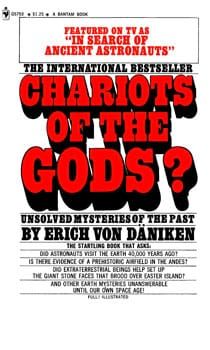
This week, we revisited a classic in the realm of pseudoscience and conspiracies – 1968’s Chariots of the Gods by serial fraudster Erich Von Däniken. For anyone unfamiliar, this is the original work that popularized “ancient aliens” theories by taking established sci-fi tropes about alien influence on the development of civilization and sort of just saying “hey, what if this were real?”
Rather than a clear and coherent thesis, von Däniken presents more of a loose metanarrative about alien contact that touches randomly on various interesting antiquity sites, myths, religious teachings, and artifacts to suggest aliens must have been involved. There are a lot of question marks in the book, and in interviews von Däniken was one of the modern pioneers of the “just asking questions” defense. He asks questions like: “What if the Nazca lines are a landing strip for alien spacecraft? What if the Mayan King Pakal was an alien astronaut? What if the biblical flood was part of an alien eugenics program? What if aliens had elaborate breeding programs with early humans and moved the less desirables to certain continents?”
Few books have less faith in humanity. Chariots of the Gods is written in a frantic yet condescending tone that almost sounds more 19th century than 20th century (this could be due to the fact that the book had heavy rewrites from a former Nazi propagandist, Ultz Utermann), but even ignoring his asides about the ineptitude of “primitives,” “savages,” and “jungle people,” it’s impossible to escape the strange and depressing premise that humans couldn’t possibly accomplish anything by themselves. The ancient aliens thesis operates as a malleable magic bullet that strips humans of agency and accomplishment while replacing religious myths and cultural unknowns with… well, more unknowns, because attributing something to unknown aliens isn’t particularly different than attributing it to the supernatural.
Unsurprisingly, von Däniken rails against narrow-minded archaeologists and stuffy intellectuals that reject his ideas. This is a deeply ironic position because the concepts proposed in Chariots of the Gods are extremely narrow-minded. Von Däniken chooses to ignore the complex socioeconomic structures, motivations, myths, culture and ambition of humans that results in development of calendars, building elaborate places of worship, symbolism in art or story. He seeks instead for a simple solution that ultimately seems based on what was popular at the time – space travel. Impressive early map? Aliens. Accurate calendar? Aliens. Mummification? Aliens. Masonry? Aliens. Roads? Aliens.
There is no point to debunking any claim. Chariots of the Gods floods the reader with examples paragraph to paragraph with little supporting evidence. Aside from that, von Däniken’s general playbook is to:
- Exaggerate the physical nature of a given location or relic
- Pretend archaeologists only have simple explanations
- Reaffirm local humans could never have done this
- Say it is aliens
- Play dumb and bullshit as needed
Checking a dozen odd examples across reading, I found nothing credible from von Däniken, even when accounting for contemporary understanding in the 1960s. The most real thing in the book is that sinking feeling in your gut when you realize you’ve been scammed.
Some people will still say it’s fun – you know, we should all lighten up a bit! Where’s your imagination? Of course, this was part of Von Däniken’s own sales pitch, so anyone can feel free to repeat the book’s advertising. Here’s the issue: this Chariots of the Gods isn’t fun, imaginative, or novel.
Even as a short work, it is incredibly repetitive and the wheels fall off quickly. After a dozen or so examples in a chapter, even von Däniken himself starts to get bored and lazy. For example, numerous photographs have captions like “some more paintings.”
The fatuous lines of inquiry are funny at first but get dull quickly. Here is a sampling:
On the Nazca Lines:
“What use were roads that run parallel to each other to the Incas? That intersect? That are laid out in a plain and come to a sudden end?”
On a cave painting in Zimbabwe:
“This reclining figure is clad in chainmail and wears curious headgear. It might be the burial of a king. It might just as likely be an astronaut receiving supplies.”
On Sacsayhuaman in Peru:
“And what did these great steps lead to? A throne for giants perhaps?”
On Mesopotamian Gods:
“Why should ancient gods be associated with the stars?”
This grates on the reader. Large sections of the book simply become short paragraph after short paragraph repeating “look at this thing. What if it’s aliens? Look at this other thing. What if it’s aliens?” As demonstrated above, so many of these “just questions” are just bad questions.
Even if you are generous as possible as a reader, Von Däniken’s own speculation is mostly narrow-minded and superficial: if you squint, ceremonial garb in carvings might look like the astronauts from the Apollo mission he includes for comparison. But why would we assume aliens capable of interstellar travel look anything like humans on their first forays into space? Indeed, Von Däniken’s perspective is hopelessly locked into a reflexive, contemporary worldview. This made even more obvious when reading in 2026 as he talks about popular tools like slide scales, which would be familiar to readers in the mid 20th century but look like relics themselves today. If we have no use for them anymore, it’s hard to imagine advanced aliens packing one for a trip to another galaxy.
If I could guess, I think most people who entertain the ancient aliens thesis do not read von Däniken directly, and furthermore most of them don’t have serious convictions about it. Some definitely do – I’ve met a couple – but lots fall into the “this is just fun to think about” category. They probably read a bit about it online, maybe they watch that History channel documentary or a YouTube video essay, or maybe on a podcast like ours. I think that those mediums probably make the whole thing more fun. In video you can have creepy music and digital zooms, people reacting or cuts to fun graphics. Message board discussions are cryptic and odd. Podcasts can be fun even if people have no idea what the heck they are talking about. I think for many, the theory lives more as sci-fi with a “what if it’s real” gimmick, sort of like the marketing around The Blair Witch Project or Cannibal Holocaust in decades past.
I’d encourage any of those people to go straight to the source and read the book directly. When accompanying stimuli are stripped away and you are stuck with von Däniken’s words, straight from the firehose, for 200 odd pages, the fun is gone, too. What you are left with is a deeply cynical grift that pisses on actually exciting, actually fun things to read about from human history. In Chariots of the Gods, the wonder of so many fascinating myths, epic events, places, achievements and tragedies is homogenized into an explanation so bland you can almost see the shrug: “could just be aliens ¯\_(ツ)_/¯.”
Otherwise, Von Däniken pads the work with a lot of rants about how we are in a great age of discovery, how we are shedding the old and how we are embracing a bright future. Of course, this is less about true optimism and more about undermining the consensus and priming the reader, but buried in those rants was one quote that I thought perfectly encapsulates the failure of his approach. He writes, "as soon as we look at the past with our present-day gaze and use the fantasy of our technological age to fill up the gaps in it, the veils that shroud the darkness begin to lift." Indeed, his most lucid contribution in the text may be this accidental articulation of the root problem with the ancient alien perspective.
In the end, it is pseudoscience, it is conspiracy, but mostly Chariots of the Gods is just bad sci-fi with a “what if it’s real” marketing gimmick. It’s also pretty damn racist. That said, the overall work is such an overwhelming pile of shit that those flavours too somehow get lost in the sauce. But nonetheless, the book has a legacy. Where von Däniken ostensibly dedicated his life to challenging myths, all he did was create a newer, lazier one.
Review by /u/admiralfartmore