The Hardy Boys: Footprints Under the Window by Franklin W. Dixon

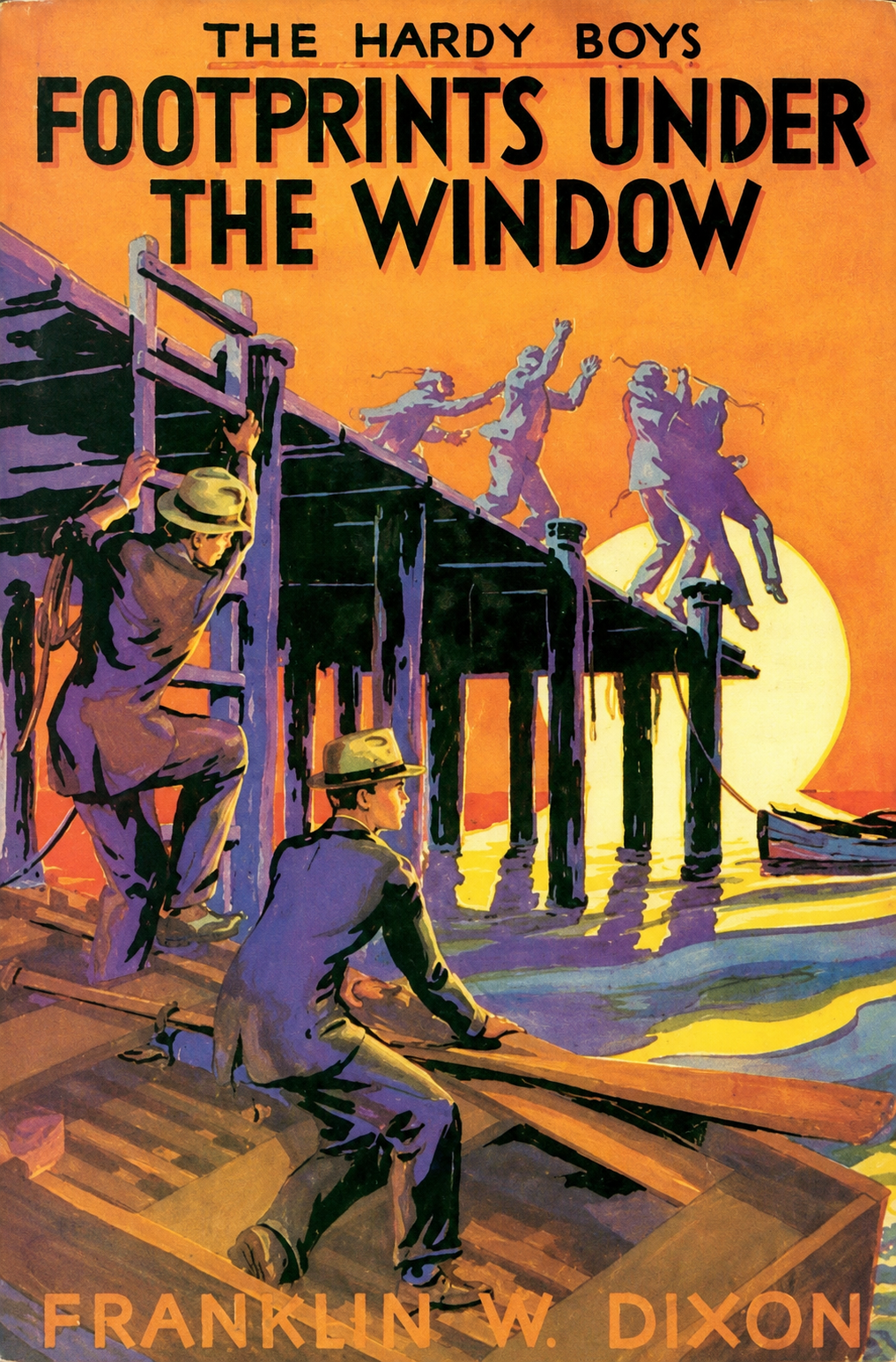
This week we’ve decided to cut into a slice of literature that’s possibly even more American than apple pie; the Hardy Boys.
Although there’s 190 books in the main canon (“Hardy Boys Mystery Stories”), if you add all the book series there’s almost 500 books about brothers Frank and Joe. Published since 1927, the Hardy Boys are celebrating their 99th birthday this year – and are still going strong. They’ve sold more than 70 million copies, and spawned the Nancy Drew series for girls, which was hugely influential to get girls reading, and sold even more copies (200 million).
Joe and Frank are the Hardy Boys; two teenage brothers (one with blond hair, one with brown) who live in fictional small-town on the Atlantic Coast of New England. Theirs is a picture-perfect world of mid-century American nostalgia and all its suburban middle-class values. They are tough and brave. They have know-how and can-do. They are hetero but also non-sexual. They are masculine and are of course lily white. This genre has been referred to as “fetishized squareness”, but as Daniel Lefferts recently wrote in the New York Review of Books, “It’s hard to imagine a product more mainstream, more embedded in the very DNA of America, than the Hardy Boys.” You have to suspend disbelief to read these books; firstly, because of the amazing amount of crime, espionage, kidnapping, and the like that takes place in this small town. But also, two teenage boys are able to run around beating up criminals and spies and mafiosos.
And the way they were written was perhaps equally as American. Although published by the author Franklin W. Dixon, no such man existed. The Boys’ creator was Edward Stratemeyer, a book packager who wanted to mass publish books at the lowest cost possible. He used teams of ghostwriters to author the Hardy Boys and Nancy Drew, paying them a pittance, refusing to grant them any licensing rights, and slashing their pay during times of economic crisis. Most of the early books were actually written by a Canadian - Leslie MacFarlane – who based the fictional town on his own northern remote northern Ontario hometown. He loathed the process, was paid a pittance, but played perhaps the most significant role in defining what came to be an American cultural institution.
The books were wildly successful, spawning the first ever reading craze among children that was unmatched until the time of Harry Potter. But they weren’t without controversy; the books were seen as low literature by many who thought the kids should be reading Shakespeare and the Classics instead. But also, authority figures were often presented as bumbling and incompetent, a slightly too subversive take for the paternalistic culture of the times.
They also carry the views of their times, especially regarding gender and race. And it is here that these books are the most shocking. They are filled with racial caricatures so offensive, that we couldn’t even bring ourselves to read them out on the podcast. It’s actually a bit of a challenge to talk about the racist content without repeating it ad nauseum.
The plot of Footprints is relatively simple. Joe and Frank need some clothes cleaned, so they go to their favorite Chinese laundry. Here they encounter Louie Fong, the embodiment of ‘yellow peril’ attitudes that saw Asian men as feminized, immoral, wicked and ugly. Fong cackles as he twists his moustache, while the boys refer to him solely with several different dated and offensive terms that I’d rather not put here.
Perhaps even worse than how they are visualized is how the Chinese characters speak. They speak in a form of pidgin English so atrociously caricature that even in the 1930s when the book was written, they must have seemed a bit much.
“Where’s Sam Lee now?” Joe inquired. “Any chance that he’ll be coming back?”
“No wantee hear about Sam Lee!” shouted Louie Fong with sudden anger. “No talkee ’bout him. Gone away. No come back.” He was in a towering rage. His lanky, skinny hand pointed toward the door.
“Go ’way!” he ordered shrilly. “Why you come here and talkee, talkee, ask question? Laundly not leddy until tomolla. Go ’way. Come back tomolla.”
All of the Asian characters speak this way, with the exception of the Boys’ friend Sam Lee, who we are told speaks without accent like a normal person. But it’s not only ethnic minorities that the books hate, it’s also people who are physically different. The Hardy Boys’ best friend is Chet Morton. The narrative goes out of its way to remind you how fat and stupid Chet is. He is constantly stuffing his face with pie or snacks, while the others mock him for his weight. Women, meanwhile, are present only to nag, scold or to panic, and never have more than a few words of dialogue.
The Boys uncover a smuggling ring in the laundry, supported by a local fishing magnate who is helping traffic Chinese indentured labour into the country. The Boys try to foil the plot, but their detective father actually does so instead, rescueing the Boys, and rendering the whole plot completely pointless.
This is book 12 in the series, but the following two books are also famous for their racism; in Book #13 “The Mark on the Door” the Boys travel to Mexico, encountering nothing but “half-breeds” and lazy locals. In Book #14 “The Hidden Harbor Mystery” the Boys tussle with a local African-American thief that speaks in horrendous caricature. When they catch the thief, the locals throw ropes over tree boughs and there is suddenly a lynching scene in the middle of a children’s book.
These books were so offensive that even by the 1960s, they were almost completely re-written. This is ironic, since the original author of the 1930s draft of these books is on record for saying that the publisher was demanding he put more racist tropes in the books, and protested that he put so few. The 1960s rewrites completely remove the Chinese and African-American characters and replace them with Central American ones, but they are still shockingly offensive.
Trying to come to terms with what books like the Hardy Boys mean is not easy. With Nancy Drew they are often credited with getting a generation to read and sparking the first reading revolution among children. That is significant in terms of history, literature and popular culture. The books are landmarks. But it’s equally important to remember who was doing the reading (middle class white children) and what they were reading. These books didn’t get everyone reading; they got a certain part of the population reading, and did so by feeding them horrendous racial stereotypes.
You might think that these problems are from another time and place, a different century whose outdated values have no place in 2026. You’d be wrong. Recently, a right-wing American press known as Passage Publishing has decided to republish the original unedited and more offensive Hardy Boys books, complaining that the 1960s versions were “too woke.” The Hardy Boys, in all their offensiveness, still hold pride of place in the American cultural mindset, as do the racial stereotypes within them.
Finally, and this is far from the worst thing in the book, but how did they settle on calling the book “The Footprints Under the Window” when the title “The Case of the Dirty Laundry” was just sitting there? That’s just offensive.
Review by u/beaudashington
Subreddit: www.reddit.com/r/pieceofshitbookclub
Also, we added a voicemail if any book club members want to leave a message for the show.