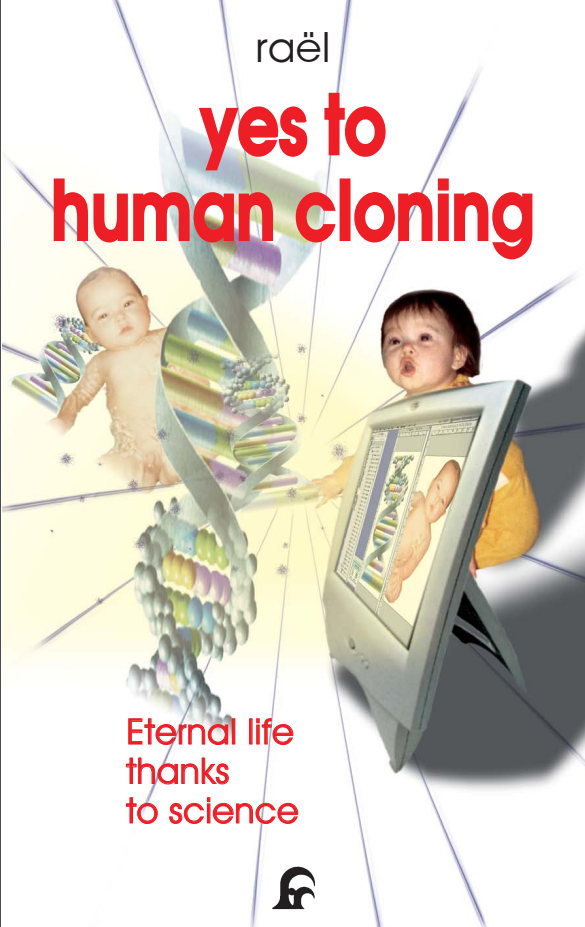
Yes to Human Cloning by Raël

On December 13, 1973, a young man named Claude Maurice Marcel Vorilhon was hiking at the Puy de Lassolas volcanic crater in France when he saw a light in the fog. A figure emerged sporting long hair, a beard, and a skin tone that “looked a bit like someone with liver problems.” Was it a lost homeless man? No - it was an alien. And over the next 6 days, it shared with Claude all the secrets of humanity’s creation.
The alien explained to Claude that the Christian bible in fact told a story of his people - the Elohim - traveling to earth, terraforming it, and creating humans as modified clones of themselves. Claude was tasked with spreading the word to humanity. He took a new name, Raël, designed a logo fusing a swastika with a Star of David, and the oddball UFO cult Raëlism was born.
In 2001, Raël released “Yes To Human Cloning,” a sort of techno-optimist manifesto on describing a near-future utopia enabled by cloning, AI, nanobots, the internet, and every other trendy bit of technology at the time. How optimistic is it? Well for one, Raël suggests “nothing unifies humanity more than the internet.” Not quite.
Outside the UFO stuff, Raëlians built their reputation from the 70s onwards as radically progressive and focused on sexual liberation. At times I’ve seen them described derisively as more of a swingers club than an actual religion, but generally speaking Raël’s priorities centre on a world where people are free to engage in pleasure. Cloning, or at least how Raël understood it to work, is presented as a key ingredient for defeating death, as well as unshackling humanity from the bondage of work such that we may focus on the bondage of play.
At a glance, living forever with no boss bugging me or my wife doesn’t sound too bad, until Raël tries to lay out exactly how it’s all going to work. Loosely, cloning will enable us to have endless organs to harvest and/or bodies to inhabit once we can transfer our consciousness around. That means most people will be able to live to 700 to 900 years, and some people will live forever. Around the time we scale these breakthroughs, the Elohim will return to earth and share even more advanced technology with us, enabling a utopia.
Raël dispels a lot of weak arguments against cloning and conveniently ignores the strongest arguments. There is no serious ethical discussion of cloning in this book, or even if it would really be you if your consciousness were replicated elsewhere. He also ignores the arguments put forth by Michael Keaton’s film 1996 film Multiplicity – how does one self-actualize amid infinite clones and no purpose? What if one of your clones is cooler than you and has sex with your wife? What if one of your clones makes a clone of himself, and it comes out all I Am Sam?
But you must forgive Raël if he is vague on details - he’s more of a big picture guy. That big picture is a future where we don’t just extend our own lives through cloning, we also have unlimited “biological slaves” to do our chores. Why should they be biological and not just robots? Well, Raël argues:
“I’m sure you’d agree that rather than having a metallic robot that looks like a souped-up tin can doing the vacuuming around the house, it would be much more pleasant if it were a beautiful, perfectly-proportioned young woman… it could have sexual organs, but sterile ones designed solely for the pleasure of its owner. Once again, it need not have any more emotions or psychological sufferings than an inflatable doll.”
Wowee, I didn’t know this was a romance novel.
With all necessary work done by our robot zombie clone underlings, humans are free to pursue the arts, explore the universe, and so on. It’s sort of Star Trek gay luxury space communism stuff minus any ethical foundation and some mirror universe oddities sprinkled in. He posits that society will be unified under a “geniocracy” where only the highest IQ individuals (and great artists, etc) will be able to vote, but doesn’t work through any possible drawbacks to that. He also dedicates no time to considering who controls the robots and slaves that have displaced the entire human labour force and any problems that might bring. Somewhat bizarrely, he retains a serious concern about overpopulation in a world with limitless resources and space travel, and suggests people who procreate should be denied the clone-based eternal life. At any rate, as you work through the details of his utopia, it begins to emerge as more of a technofascist nightmare.
Beyond the sex slaves, Yes to Human Cloning is also deeply uninspired. Rael’s excitement about nanobots, GMO foods, cloning, AI, robotics, and other technologies just reflects trends and popular discourse at the turn of the millennium. There is very little new. But that’s also sort of what Raël does, as even his original teachings in 1973 are strangely similar to ancient astronaut paperbacks published by Jean Sendy in Moon: Outpost of the Gods (1968) and Those Gods who Made Heaven and Earth (1969), with many passages and terms being virtually identical to Raël's revelations. So both as a futurist and as an alien prophet, Raël is at best derivative.
What's more, in an era where every Silicon Valley pseudointellectual is promising utopia in exchange for a bit more runway, even the wildest parts of Raël’s pitch don’t stand out much anymore. Of course, there’s the funny outfits, the publicity stunts, the sex, and the swastika fused with a Star of David, but beyond the trappings and deliberate cult aesthetics, Raëlism doesn’t bring much to the table. As we discovered playing a sort of “who said it” game on the podcast, quotes from today’s tech leaders are indistinguishable from a UFO sex cult guy famous for running hoaxes. That saturation is probably part of why the group has faded away.
Nonetheless, we had a fun time exploring this 2001 artifact and Raëlism generally. Check out the podcast for deeper discussion of both.